Friday, 11 February 2011

I Don't Want to Grow Up

One of the benefits people have when training with me is not only hearing my wonderful jokes (did you know prawns never give anything to charity? Well basically, they are shellfish) but also having to endure occasional rants about some of the people and things I have to deal with (hey, training is supposed to be cathartic).

I was training with Chris (a fellow musician) the other day and was moaning about some of the musos I've had to deal with over the last year. Chris made a very astute point: "music is one of those industries where men don't have to grow up to do it". It's very true - as evidenced by the prima donna / adolescent /egotistical behaviour of even some very succesful musos, let alone us lot at the bottom of the pile. But Chris' comment got me thinking on a wider level and it is a point that can also be made about sports and the martial arts.

I think it's fair to say that the general structure of martial arts is prime ground for motivating and encouraging the adolescent mindset. I've already referenced this before in terms of marketing and over-competetiveness. . It's hard to think of a martial arts movie that doesn't have a revenge plot as it's central theme. It is also a strong factor in the cultural perception of traditional arts, where the young man finds the older, wiser father-figure/ guru to lead him on his journey

All well and good perhaps in the right circumstances, but older doesn't neccesarily mean wiser! The hierarchical structures in many arts can be both a trap for the unwary and a purpose-built control device for the egotistical. As corny as it was, the original Karate Kid (I've not seen the JC one yet!) illustrates this point perfectly - the wise teacher encourages his student in all aspects of life and to find his own path. The adolescent/ego-driven teacher demands blind obedience and destroys the health of his students. Hollywood film-fantasy of course, but with a touch of reality to it.

What do we mean by "grown up"? To me it's a person who can exercise a degree of control over their desires and emotions, has a certain amount of self-awareness and understands the consequences of actions. Or, to put it in shorthand, isn't an a-hole! Immature behaviour can be witnessed every Saturday night outside pubs, usually by young males trying to establish a place in the pecking order and all the other things associated with pack behaviour (ie the domain of the "middle brain" as opposed to the intellectual).

The same behaviour can be seen in less directly confrontational  fashion  in even the nicest social setting, where establishing status (measured by wealth, body-type, who you know, take your pick) is very important to some people. Or in martial arts by people who have a compulsion to put down what anyone else does, whose teachers are infallible super-men,  or who feel the need to bite the hand that has fed them

In self defence terms, we have to recognise behaviour and where it comes from, both in ourselves and others. This is a very important part of training - and how you train will impact directly both on how you are viewed by others and how you react under pressure. Never being tested, physically or emotionally in training is like being raised as a spoilt child - everything is laid on a plate for you. The real world is not so forgiving.  On the other hand constant agressive practice, with no balance, will usually lead to a constantly agressive person. In everyday life this is not a recipe for a good time - you will be in conflict with those all around you. To an adolescent mindset, particularly one raised on gangster-culture (old school or new), being a tough guy or top dog, this might seem like a good thing. At least in film, music and video games it comes across like that. The reality is the pain of broken relationships, probable run-ins with the law and a life spent looking over your shoulder.

So it does sadden me when we see gangster culture being portrayed as cool in the martial arts press, or guys posing with guns as though they are hardened-killers. You tend to find that people who have been through the mill of real life-and-death violence are very mature in their outlook, quiet and humble. They understand only too well the consequences of actions and the reality of strife.

We need to understand this in ourselves too (know yourself being the Systema motto). We all have our moments and tantrums, times when we need to take a breath, take stock of what is happening and adjust accordingly. That might be something not going right in training, so we bend the rules a little in order to "win". It might be in a domestic situation where, actually your partner could have a point about your behaviour. Or it could be a potentially dangerous situation where you have to make a decision about whether to go forward or back. In each case, being immature / adolescent won't be constructive

Men in our society are coddled more than ever before. We don't have to fight wars, we generally have comfortable jobs that don't involve long hours of hard labour, we have all kinds of gadgets and toys that mean we can extend our adolescence out for our whole lives (you can prise my Star Trek phaser from my dead, cold hand). There is even now a huge range of "product" to protect our delicate skin and condition our hair (don't get me started). But amongs all of that we have to take stock of some harsh realities at times and maintaining a "grown up" attitude in training can only help. I shall leave the last word to the marvellous Tom Waits

Tuesday, 1 February 2011

CLOSE QUARTER COMBAT Part 2

Preview clip of our latest release. This DVD shows how to work in the clinch, targetting muscle groups , how to work with pressure points and ideas for pressure testing. It also includes information on the decision making process during a confrontation and the use of breathing for fear control

Competition and Conflict

Competition/ combat sports vs "reality based" self defence is always a popular and hot topic on the forums. The extreme view on each side is either that nothing comes close to MMA for replicating a fight or that "dirty moves" can easily finish off any MMA fighter. Ironically such extreme views seems to generally held by what you might charitably call the "fan-boy". You know, the guy who has all the UFC DVDs, rash guard, tee shirts and beanie hat (but never trains). Or the guy who goes shopping with three folder knives and field rations stashed in his commando pants (but never trains). In other words the typical person who gets involved in protracted this vs that forum arguments!

I've yet to meet a decent exponent of either method who is so set in their views or who fails to recognise the strengths, weaknesses, compromises, purpose and goals in any training method.

In our latest DVD release on Close Quarter Combat I talk about some of the pitfalls of the sports approach in terms of "self defence". These are largely tactical / situational - in other words taking into account the surroundings, multiple attackers, possible use of weapons, etc. On the positive side sports arts provide a safe outlet to test skills trained in the gym.  Likewise the purely self defence approach can fall into the trap of never pressure testing training methods and relying purely on second or third hand experience.

I read a post lately that said Systema needed to "prove itself" in competition to become recognised as a viable art. Of course that statement fails to recognise the background of the art  - in fact even disregard it totally when pointed out.  A follow up point was  put forward that Special Forces training is in no way comparable to training for competition. It's an..... interesting..... view and one that, for me, points to the current cultural prevalance of MMA as the premier form of martial art entertainment. I don't doubt that a few years back the same thing would have been claimed for kung-fu, karate, ninjutsu, or whatever else was currently in vogue.

I also mention on the new DVD that we can become conditioned to expect a fight to look a certain way. In my day, if you asked someone to fight you could almost guarantee they would put their hands up in a boxing guard - even if they had never had a boxing lesson in their life. That was how men had a fight (and even some women!).  Today I'm guessing it may be different.  I've long said that martial arts are an expression of the culture they were formed in and that cultural influence may not be appropriate for another place or time. That applies to modern day as much as "traditional" styles. It's probably best to have no expectations about how a fight will go - you tend to get less surprises that way.

So this can be a downside to applying competition work outside of the ring - it may not be appropriate for the situation. And whatever anyone says, if you have trained intensively in something, it is likely to come out under pressure. We tend to go for something we feel confident with - so if my choke has worked well for me in training or competition that's probably what I'll go for in a fight. That is good if it is appropriate - and well trained sports guys will no doubt have strong technique. Some people say that a person would "obviously" understand the difference in situations, but that has not always been the case in my experience - I've seen a few examples of people struggling to shoe-horn in a technique oblivious to what  is going on around them, this clip shows one such example

I think it is more productive to frame this argument in terms of studying competition vs studying conflict. The former is the study of that moment of contact and what happens when one person tries to dominate or subude another through a prescribed series of movements or techniques. That is precisely what sports combat arts have been developed for and is both their strength and  weakness. Strength because training methods and techniques can be tested, refined, improved.  The weakness comes when good methods that don't "fit the box" are rejected.  For example one of our guys is currently in Thailand, he's had a few succesful matches. When he first started training at the camp he was using figure 8 strikes and was told "good power, but don't use!". We come back to that cultural influence again, or perhaps the fact that the crowd only want to see certain types of things in certain types of competition - and let's not forget that the fight game is about bums on seats as much as any other form of entertainment.

Study of conflict encompasses that moment of physical contact, but it is also much broader in scope. We deal with conflict every day, thankfully mostly at a small scale level. But it is conflict nonetheless, and for a balanced life we have to learn to negotiate, compromise, know when to be assertive and when to back down, understand body language, be mindful of different cultural values  and all the other things involved in human interaction. I recently saw a great quote in Alex Kozma's book Warrior Guards the Mountain from one of his teachers  "It is easier to be a monk...try and be married that is much more difficult!"

Understanding the dynamics of social and personal interaction is an important aspect of any true self defence training and is for me the defining factor in categorising an art as "sport" or "street". Competition ends only with a winner and a loser. Conflict ends with anything from death to both people shaking hands and making a deal. Conflict also encompasses co-operation, which is how we help and develop each other as part of a group.  This is important to bear in mind when training. People can blur the line between doing their  best and wanting to win all the time. The latter is not constructive in training. It's easy to win if you go outside the boundaries of a drill. We also have to bear in mind that co-operation doesn't mean letting what your partner does work all the time, but providing the right level of challenge for them. That may call for compliance to help a partner learn something particular or total non-compliance in order to help them gain understanding. There is no competition as such involved in either case, but a willingness to take part in a training process in which both parties can and should learn.

With the right mindset  competition can develop humility alongside skill. I guess the "dark side" of competition is that it can build ego and pride - both of which can be a liability in self defence situations.  If you think you are the best, it's important to remember that pride comes before a fall - and the bigger the pride, the greater the fall. I know a young man virtually destroyed after taking such a fall, I can only hope he learns from the experience, chooses the people around him with a little more care and can rebuild himself.

As I previously mentioned, the flipside of the coin is the person who occasionally trains a chin jab or eye gouge on their Bob dummy and lives a life of constant,  low-level paranoia. It may be the case that windpipe crushes and similar "deadly moves" are physically quite easy to do (after all, you can crush a beer can, right?). However in "real time" they are not so easy and, perhaps more tellingly, psychologically they are not easy at all for the average, well-balanced person.

In extreme cases the results of an overly "combative" outlook  can be as equally damaging as an unhealthy emphasis on  winning at any cost. Training has to be balanced with lifestlye, it needs to be fit for purpose. Training for a specific event is different from general training. No boxer trains the same way after a big fight as before it. The requirements of a soldier or similar professional are different to a civilian. It's not to say  that we can't dip into those training methods, we can, but at the same time recognising who and where we are and what we are training for.

The other aspect of competition rife on  forums is "X vs Y". This can be anything from "Wing Chun vs Karate" to "open hand vs closed fist" to anything you can think of.  These questions are generally so context-sensitive as to be nonsensical, but it is interesting to see  how some  people think in these black and white absolutist terms. I find it  a particularly adolescent mindset -  highlighting an overly competitive approach as opposed to a co-operative one  -  a mindset that I think is encouraged within certain parts of the martial arts industry. After all, it is much easier to sell a "winner" to the public than something more subtle and long term. Of course you need a supply of new "winners", which is why people and products (people as products?) are re-cycled and re-invented on a regular basis. Most of the good work in martial arts - or any other endeavour - takes place in small, quiet steps over weeks, months, years, with the occasional breakthrough. Competition can be a part of that process, if approached in a healthy way, particularly if people have little or no experience of fights.
So for me "competition" is just one aspect of  "conflict", which makes the whole this vs that a bit redundant. Anyone who thinks a well-trained MMA athlete would be an easy proposition is naive. Anyone who thinks a gang of hostile 15 year olds would be an easy proposition is naive. There are no easy answers and the only answers come through good training, learning from your own and other's experience, applying lessons learned, good old-fashioned common sense and knowing when to compete and when to co-operate.

Tuesday, 28 December 2010

Close Quarter Combat Part One

Just finished editing our newest DVD - part one in a series of two, preparation work for close quarter fighting. Exercises, movement drills, developing flow and strike placement - vital knowledge for surviving the January sales!


We are also doing a pre-order deal for Parts 1 and 2!

Happy New Year!
Rob

Wednesday, 22 December 2010

MERRY CHRISTMAS! 2010 and beyond

I'd like to thank everyone whos helped  make 2010 a great year for training! The groups have come on leaps and bounds and we've covered a lot of interesting work this year.

In terms of workshops we've covered form and structure, knife defence, groundfighting, body language and awareness and  stretching. The regular classes have covered all the usual work which in itself is as varied and interesting as ever!

Training highlights for me include Martin Wheeler's visit to London. Martin is a great instructor and you always know it will be a good session! Another highlight was this year's Leicester training camp - some truly unique training, challenging on so many levels and beautifully organised and conducted by Ed, Rory and the rest of the crew

We've had some new faces through the door this year and I'd like to welcome you all! We have had people move away too - Steve "Bulldog" Williams, our very own shin-kicking backsword-wielding granite- jawed man of steel - is now in Somerset, home of cider! For those who are overseas at the moment I hope you are keeping safe and will soon be back with your families.

There has been a lot of interesting feedback from the regulars this year and this really helps in shaping the training sessions. It's been encouraging to see people make a suggestion during a drill which can then lead the group off on a whole new tangent. This is of prime importance to me as it shows that, even beyond any physical skill improvements, people are thinking, analysing and engaging in the process. As an instructor this is so much more rewarding than standing in front of rows of people who copy your moves or teaching through some artificial syllabus. At the same time it's also a challenge to keep the training fresh, relevant and realistic and I look forward to meeting that challenge in 2011

As Ed often says, we don't know what we are training for. By that he means if you are a boxer, you train for a boxing match. A soldier trains for whatever duties he is tasked to carry out. None of us is can see the future so in that respect we are training for the "unknown". This might be seen as a difficulty but in fact I think it is liberating. It means we aren't working under the confines of rulesets or an  SOP but are free to explore any avenue. By the same token I think this approach - which as far as I can see is unique to Systema - totally encourages innovation, creativity and freedom of expression. This is important from a psychological point of view too and of course goes hand-in-hand with the whole "we are all students" ethos. In fact to a large extent I see my role almost entirely as a signpost, either to training methods or to people better qualified to teach than I am. In that sense I owe everything to Mikhail, Vladimir and all the other good people I have trained with over the years.

In the wider "martial arts community"  2010 has been a bit of a non-descript year I think. It is interesting, though, to observe subtle changes over the industry - for example there are a lot more people teaching "defence in cars" or "working in a confined space" and one can only wonder where they draw their inspiration from. It is also interesting to see the numerous questions on forums about fear control, fluid movement, integrating ground work etc etc which often tempt me to write JDS....Just Do Systema! But of course not everything is for everyone and despite the growing evidence to the contrary people do get taken in by some of the "misunderstandings" about what we do
It is disappointing though  to see that even with the huge amount of information now available (not like when I was a boy!) people coming into martial arts still seem to  search for one of three types:

"Qualified Guy" with a string of black belts, hall of fame inductee, 15 times world champion, list of certificates that no normal wall could display and face on every magazine cover

"The Guru" - a zen-like Monk figure with mysterious powers, wrapped in a blend of Eastern philosophies and Western consumerism

"The Tough Guy" - either some kind of street hard-man bouncer or a heavily-muscled steely-eyed ex Spec Forces type, who can teach you to end a fight in 6 seconds or kill a man with a mobile phone

There are plenty who's marketing strategy revolves around  playing  up to such stereotypes and why not - it's a free world (well actually it can work out quite expensive if you don't read the small print). Of course the media - even the mainstream martial arts media - does nothing to dispel the myths.

The reality is that teachers can come in all shapes and sizes and sometimes when you least expect them. There are of course 100s of good instructors out there who are honest about their abilities, don't inflate or invent their CVs and want only the best for their students. Overall I don't feel they are very well served by the "industry" who are more interested in mutual back-slapping and self-promotion than anything else (there goes my invite to next years "big event!)

So what does 2011 hold in store? On the DVD front the first release  will be a (probably) two disk set on close quarter work. Part 1 is being edited now and will hopefully be ready at the start of January.

In terms of regular class training - more of the same, plus! There were a some good suggestions at the last session, so I'll take those on board, plus of course any specific areas that anyone wants to cover. I'm talking to an old pal of mine who currently does a lot of work with behaviourial patterns,  so that may be the subject of a workhsop in the future. Hopefully there will be at least one training weekend this year and I also plan on getting the group out and about to train at a couple of different locations. There may also be the possibility of a training trip to Toronto (if Heathrow ever opens again!)

In closing I'd like to again thank everyone who's attended the classes and workshops this year,  my teachers, friends and colleagues and everyone who has helped make this such an enjoyable year - most of all my wife who let's me out every Saturday morning to play for a couple of hours!

Merry Christmas and a peaceful, healthy and happy New Year to you all

God Bless

Rob

Sunday, 5 December 2010

December 2010 Workshop

A big thanks to everyone who made the workshop yesterday - good to see people from all the different groups coming together and training with such good spirit!

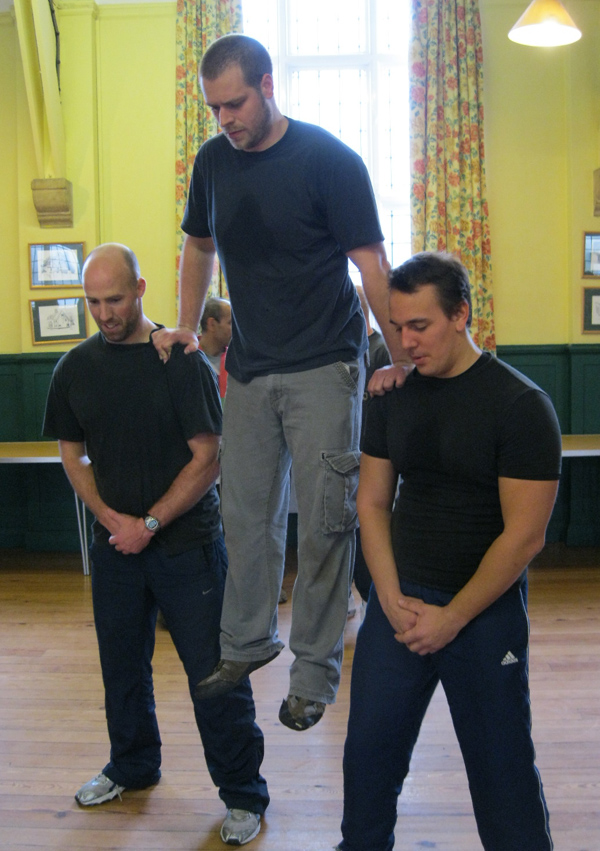
For those who couldn't make it - the work centered around close-range fighting, so the drills were based around close contact with other people, developing short range strikes, takedowns, etc. We had fun with some different exercises and though time beat us as always (perhaps we will run through the remaining drills next session) we got plenty of work in. The highlight for me was seeing how intense the guys worked in the three man fight drill  - without protective gear, yet thanks to good control and good self-protections skills there were no injuries. I'll be reviewing the video footage and if it's good will edit up for a DVD release. In the meantime here's a few pics

Thanks again

Rob