Just finished editing our newest DVD - part one in a series of two, preparation work for close quarter fighting. Exercises, movement drills, developing flow and strike placement - vital knowledge for surviving the January sales!
We are also doing a pre-order deal for Parts 1 and 2!
Happy New Year!
Rob
Tuesday, 28 December 2010


Wednesday, 22 December 2010
MERRY CHRISTMAS! 2010 and beyond
I'd like to thank everyone whos helped make 2010 a great year for training! The groups have come on leaps and bounds and we've covered a lot of interesting work this year.
In terms of workshops we've covered form and structure, knife defence, groundfighting, body language and awareness and stretching. The regular classes have covered all the usual work which in itself is as varied and interesting as ever!
 Training highlights for me include Martin Wheeler's visit to London. Martin is a great instructor and you always know it will be a good session! Another highlight was this year's Leicester training camp - some truly unique training, challenging on so many levels and beautifully organised and conducted by Ed, Rory and the rest of the crew
We've had some new faces through the door this year and I'd like to welcome you all! We have had people move away too - Steve "Bulldog" Williams, our very own shin-kicking backsword-wielding granite- jawed man of steel - is now in Somerset, home of cider! For those who are overseas at the moment I hope you are keeping safe and will soon be back with your families.
 There has been a lot of interesting feedback from the regulars this year and this really helps in shaping the training sessions. It's been encouraging to see people make a suggestion during a drill which can then lead the group off on a whole new tangent. This is of prime importance to me as it shows that, even beyond any physical skill improvements, people are thinking, analysing and engaging in the process. As an instructor this is so much more rewarding than standing in front of rows of people who copy your moves or teaching through some artificial syllabus. At the same time it's also a challenge to keep the training fresh, relevant and realistic and I look forward to meeting that challenge in 2011
 As Ed often says, we don't know what we are training for. By that he means if you are a boxer, you train for a boxing match. A soldier trains for whatever duties he is tasked to carry out. None of us is can see the future so in that respect we are training for the "unknown". This might be seen as a difficulty but in fact I think it is liberating. It means we aren't working under the confines of rulesets or an SOP but are free to explore any avenue. By the same token I think this approach - which as far as I can see is unique to Systema - totally encourages innovation, creativity and freedom of expression. This is important from a psychological point of view too and of course goes hand-in-hand with the whole "we are all students" ethos. In fact to a large extent I see my role almost entirely as a signpost, either to training methods or to people better qualified to teach than I am. In that sense I owe everything to Mikhail, Vladimir and all the other good people I have trained with over the years.
 In the wider "martial arts community" 2010 has been a bit of a non-descript year I think. It is interesting, though, to observe subtle changes over the industry - for example there are a lot more people teaching "defence in cars" or "working in a confined space" and one can only wonder where they draw their inspiration from. It is also interesting to see the numerous questions on forums about fear control, fluid movement, integrating ground work etc etc which often tempt me to write JDS....Just Do Systema! But of course not everything is for everyone and despite the growing evidence to the contrary people do get taken in by some of the "misunderstandings" about what we do
It is disappointing though to see that even with the huge amount of information now available (not like when I was a boy!) people coming into martial arts still seem to search for one of three types:
"Qualified Guy" with a string of black belts, hall of fame inductee, 15 times world champion, list of certificates that no normal wall could display and face on every magazine cover
"The Guru" - a zen-like Monk figure with mysterious powers, wrapped in a blend of Eastern philosophies and Western consumerism
"The Tough Guy" - either some kind of street hard-man bouncer or a heavily-muscled steely-eyed ex Spec Forces type, who can teach you to end a fight in 6 seconds or kill a man with a mobile phone
There are plenty who's marketing strategy revolves around playing up to such stereotypes and why not - it's a free world (well actually it can work out quite expensive if you don't read the small print). Of course the media - even the mainstream martial arts media - does nothing to dispel the myths.
The reality is that teachers can come in all shapes and sizes and sometimes when you least expect them. There are of course 100s of good instructors out there who are honest about their abilities, don't inflate or invent their CVs and want only the best for their students. Overall I don't feel they are very well served by the "industry" who are more interested in mutual back-slapping and self-promotion than anything else (there goes my invite to next years "big event!)
So what does 2011 hold in store? On the DVD front the first release will be a (probably) two disk set on close quarter work. Part 1 is being edited now and will hopefully be ready at the start of January.
 In terms of regular class training - more of the same, plus! There were a some good suggestions at the last session, so I'll take those on board, plus of course any specific areas that anyone wants to cover. I'm talking to an old pal of mine who currently does a lot of work with behaviourial patterns, so that may be the subject of a workhsop in the future. Hopefully there will be at least one training weekend this year and I also plan on getting the group out and about to train at a couple of different locations. There may also be the possibility of a training trip to Toronto (if Heathrow ever opens again!)
In closing I'd like to again thank everyone who's attended the classes and workshops this year, my teachers, friends and colleagues and everyone who has helped make this such an enjoyable year - most of all my wife who let's me out every Saturday morning to play for a couple of hours!
Merry Christmas and a peaceful, healthy and happy New Year to you all
God Bless
Rob
In terms of workshops we've covered form and structure, knife defence, groundfighting, body language and awareness and stretching. The regular classes have covered all the usual work which in itself is as varied and interesting as ever!

We've had some new faces through the door this year and I'd like to welcome you all! We have had people move away too - Steve "Bulldog" Williams, our very own shin-kicking backsword-wielding granite- jawed man of steel - is now in Somerset, home of cider! For those who are overseas at the moment I hope you are keeping safe and will soon be back with your families.


It is disappointing though to see that even with the huge amount of information now available (not like when I was a boy!) people coming into martial arts still seem to search for one of three types:
"Qualified Guy" with a string of black belts, hall of fame inductee, 15 times world champion, list of certificates that no normal wall could display and face on every magazine cover
"The Guru" - a zen-like Monk figure with mysterious powers, wrapped in a blend of Eastern philosophies and Western consumerism
"The Tough Guy" - either some kind of street hard-man bouncer or a heavily-muscled steely-eyed ex Spec Forces type, who can teach you to end a fight in 6 seconds or kill a man with a mobile phone
There are plenty who's marketing strategy revolves around playing up to such stereotypes and why not - it's a free world (well actually it can work out quite expensive if you don't read the small print). Of course the media - even the mainstream martial arts media - does nothing to dispel the myths.
The reality is that teachers can come in all shapes and sizes and sometimes when you least expect them. There are of course 100s of good instructors out there who are honest about their abilities, don't inflate or invent their CVs and want only the best for their students. Overall I don't feel they are very well served by the "industry" who are more interested in mutual back-slapping and self-promotion than anything else (there goes my invite to next years "big event!)
So what does 2011 hold in store? On the DVD front the first release will be a (probably) two disk set on close quarter work. Part 1 is being edited now and will hopefully be ready at the start of January.

In closing I'd like to again thank everyone who's attended the classes and workshops this year, my teachers, friends and colleagues and everyone who has helped make this such an enjoyable year - most of all my wife who let's me out every Saturday morning to play for a couple of hours!
Merry Christmas and a peaceful, healthy and happy New Year to you all
God Bless
Rob
Monday, 20 December 2010
Sunday, 5 December 2010
December 2010 Workshop
A big thanks to everyone who made the workshop yesterday - good to see people from all the different groups coming together and training with such good spirit!
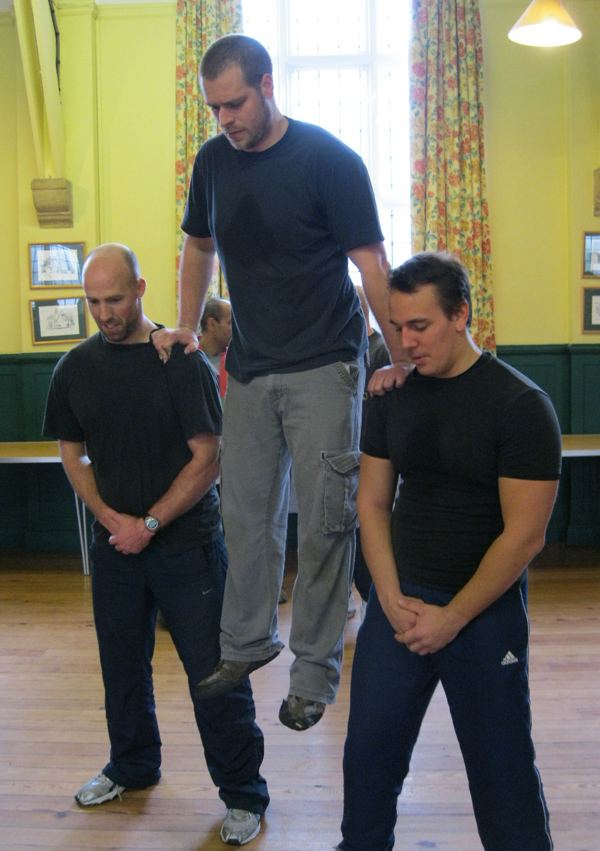
For those who couldn't make it - the work centered around close-range fighting, so the drills were based around close contact with other people, developing short range strikes, takedowns, etc. We had fun with some different exercises and though time beat us as always (perhaps we will run through the remaining drills next session) we got plenty of work in. The highlight for me was seeing how intense the guys worked in the three man fight drill - without protective gear, yet thanks to good control and good self-protections skills there were no injuries. I'll be reviewing the video footage and if it's good will edit up for a DVD release. In the meantime here's a few pics
Thanks again
Rob


Monday, 29 November 2010
To Spar on not to Spar
It's a perennial question in the martial arts world and one that continues to ignite debate. In some places it also seems to have become an indicator of whether your art is effective or not, if it is "alive" - ie you work against a "resisting opponent"
 Sparring in the generally accepted sense means two people, usually with some form of protective gear, working within a sports-based ruleset over a set period of time or rounds. Adherents to this method point to benefits such as technique development, good stamina and working under pressure as the main benefits to be gained. But are there drawbacks to this kind of sparring as well? I think there are and, depending on your training goals they can have a negative influence on your development
First let me say that I'm not of the "too deadly to spar" school. This is often used as an excuse to never engage in any type of work outside of a fixed response pattern, which even at basic levels of training is of very limited value. On the other hand there are of course real safety factors to consider and no-one would suggest we regularly break each other in training in the name of "realism"
But if your goal is to study self-protection , sports-based sparring is of limited value. To begin with look at the range and set-up of sparring vs fight. Actual fight range is very close - I'm talking about a person intent on causing serious harm here rather than arguing or a pushing match. When a person is in the mindset of wanting to knock your block off they close in very quick. They want to punch, grab, bite, It's a very different experience from touching gloves then maintaining a safe distance while you feel each other out.
There is a psychological aspect to consider too. A highly agitated and aggressive person is acting off of primal instinct rather than a carefully though out strategy. That in itself can be overwhelming and needs to be prepared for.
 We must also take into account environmental factors. Sparring takes place on mats or in a similar "safe" area. Real life incidents can happen anywhere at any time. As I write this outside it's dark, cold and icy. Not ideal conditions. You may be seated, on a bus, with family or friends. There is your own condition to consider too - you could be injured, tired, drunk (shurely not!) or feeling on top of the world
In short there are countless variable factors to any situation, and we haven't even mentioned weapons or groups yet. None of these factors are replicated in the conventional "sparring" situation. One more thing to think about is that the sparring experience replicates only a very specific moment of any situation - the actual physical hitting/grappling part. If we are serious about self-protection we need a wide range of awareness and observation skills, how to read people, good communication skills not to mention a reasonable understanding of legal and associated issues.
 I feel that to just train in conventional sparring is not sufficient to develop good self-protection skills. But with a little work we can get the benefits of good sparring while avoiding the pitfalls. An easy way to do this is to run goal-based sparring sessions. These can be as simple or as involved as you like. On a simple level give one person two minutes to get through a door and the other person has to prevent them doing so. You can add in other conditions as neccesary to simulate different situations
This can develop into very sophisticated drills, such as the ones put together by Ed and Rory at this year's training camp, which put people through a range of physical and emotional challenges. As they ably demonstrated real self-protection work isn't all about being "tough" and charging through everything like a bear with a toothache, it is about having the skills to assess a situation and react accordingly. It's not often how self-defence is "sold" - people like an easy answer or a "no fail technique" that will get them out of trouble. The truth is unfortunately more involved than that, even the simple solution of giving someone a slap can have consequences way beyond the original situation.
So to spar? Yes - but with conditions. As with all training be aware of the strengths and weaknesses of the drill. Having a good ground grappling session helps develop skills and is a good workout (probably the most real you can get without injury). Gloving up and having a spar is good for hitting and getting hit, movement and developing tenacity. For instructors who run these drills - every now and then throw something different into the mix. Three people boxing instead of two. Chuck a knife to one of the grapplers. At least that will keep your people on their toes and stop them getting too "sparring" fixated. To take it beyond that start working the type of drill mentioned earlier, keep it safe, keep it challenging and keep it grounded in reality and personal experience - then sparring becomes a useful tool

First let me say that I'm not of the "too deadly to spar" school. This is often used as an excuse to never engage in any type of work outside of a fixed response pattern, which even at basic levels of training is of very limited value. On the other hand there are of course real safety factors to consider and no-one would suggest we regularly break each other in training in the name of "realism"
But if your goal is to study self-protection , sports-based sparring is of limited value. To begin with look at the range and set-up of sparring vs fight. Actual fight range is very close - I'm talking about a person intent on causing serious harm here rather than arguing or a pushing match. When a person is in the mindset of wanting to knock your block off they close in very quick. They want to punch, grab, bite, It's a very different experience from touching gloves then maintaining a safe distance while you feel each other out.
There is a psychological aspect to consider too. A highly agitated and aggressive person is acting off of primal instinct rather than a carefully though out strategy. That in itself can be overwhelming and needs to be prepared for.
In short there are countless variable factors to any situation, and we haven't even mentioned weapons or groups yet. None of these factors are replicated in the conventional "sparring" situation. One more thing to think about is that the sparring experience replicates only a very specific moment of any situation - the actual physical hitting/grappling part. If we are serious about self-protection we need a wide range of awareness and observation skills, how to read people, good communication skills not to mention a reasonable understanding of legal and associated issues.

This can develop into very sophisticated drills, such as the ones put together by Ed and Rory at this year's training camp, which put people through a range of physical and emotional challenges. As they ably demonstrated real self-protection work isn't all about being "tough" and charging through everything like a bear with a toothache, it is about having the skills to assess a situation and react accordingly. It's not often how self-defence is "sold" - people like an easy answer or a "no fail technique" that will get them out of trouble. The truth is unfortunately more involved than that, even the simple solution of giving someone a slap can have consequences way beyond the original situation.
So to spar? Yes - but with conditions. As with all training be aware of the strengths and weaknesses of the drill. Having a good ground grappling session helps develop skills and is a good workout (probably the most real you can get without injury). Gloving up and having a spar is good for hitting and getting hit, movement and developing tenacity. For instructors who run these drills - every now and then throw something different into the mix. Three people boxing instead of two. Chuck a knife to one of the grapplers. At least that will keep your people on their toes and stop them getting too "sparring" fixated. To take it beyond that start working the type of drill mentioned earlier, keep it safe, keep it challenging and keep it grounded in reality and personal experience - then sparring becomes a useful tool
Saturday, 27 November 2010
Man and Superman

Sales of comic books and movie spin-offs are at an all time high, we all enjoy Spidermanm, the X-Men and co. Magicians and mentalists such as Derren Brown are doing very well too. Running parallel to that is the NLP / psychology industry which has made huge inroads into the corporate market.
The martial arts world has always been fertile ground for superhuman feats. Every culture has its myths and legends, from Achilles to Cuchulain to Mu Lan to King Arthur. Many martial art styles have roots in mystic practices - Shaolin temple, ninjitsu, Zen monks. They often talk about developing "superhuman" powers. Traditionally these might inlcude things such as - light body skills (the ability to jump high distances from a standing start), poison hand/ dim mak (the ability to kill with a touch), telekenesis (the ability to move people or objects with the power of the mind), telepathy (the ability to read others' thoughts) and so on. In popular culture martial arts masters are able to display any or all of the above thanks to years of rigorous training in their respective disciplines.

So do these things exist? Are there really people who can read your thoughts and kill you with a mere touch? In recent history both major superpowers obviously thought it was an area worth investigating. The USA set up groups like the Stargate Project, the Soviets had similar programs running (in fact the book Experiments in Mental Suggestion discusses research as far back as the 1920s). As you might expect from the Cold War era it is difficult to draw definite conclusion from amongst the fog of secrecy, competition, desire for funding and mis-information. However I can't help feeling that if anything truly substantial had been achieved we would have had some kind of trickle-down effect by now
On a more personal level over the past 30 years I've experienced a wide range of teachers, some of whom claimed "special powers". In fact some of whom built their whole persona around those powers. So I've seen most of the no-contact people, a few ninjas and various type of chi-power exponents. In 100% of cases where their powers were heavily promoted, I thought their work was totally explainable through mundane psychology. They were very good at leading, establishing rapport, cold reading and so on. In even less savoury cases they were very skilled at manipulating the psyche of their students through what could probably best be described as "grooming". Of course there are a few Youtube clips of what happens when these teachers try and work with someone who hasn't been through the process - with predictable results!
On the other hand I've met a few people who demonstrated interesting skills not so easily explainable. The big difference was these skills manifested in normal situations rather than as a show-piece. No attention was drawn to them, they weren't presented as anything special. No money changed hands either!

Let's take a simple example, the hunter who lives and works in the forest, the commuter who works in the city. Switch environments and both will struggle. The commuter in the forest will not be able to predict the coming change in weather, see animal tracks, pick up the distant scent of woodsmoke. To the city dweller these may appear to be "superhuman" abilities (Crocodile Dundee) when in fact they are the result of training, experience and finely honed natural senses.
You can apply the same thing to human interaction. Those of you who trained at our Body Language Workshop recently will now be able to pick out some good indicators of stressful behaviour. When you get good at this you can amaze people by telling them what they are thinking in some circumstances. It isn't telepathy - you aren't literally getting a word flash up in your mind - but you can "read" them through the physical indicators. Refine that skill to a higher level and you can understand how some people disappear from view, confuse you into forgetting your name and all the other things that a skilled operator or "mentalist" can achieve. That's not to say there isn't trickery involved in stage mentalism though, as anyone who has seen my "mind reading" routines will know!
So "superhuman" abilities are a fantasy. Either the wishful thinking of someone wanting to be a lot more than they are, or the bait on a hook to reel in the vulnerable and gullible. Developed human potential is something esle altogether - but even then this development takes part alongside regualr training, it grows alongside the "bread and butter" skills. To sell it as some sort of instant "add-on" is also misleading in my view. There is also an issue of potential harm for anyone undergoing some types of training without adequate qualified supervision, that applies equally for physical and psychological work
I guess the old adage applies at the end of the day "if it sounds too good to be true, it is"
I'll leave you with a story I heard about an instructor up in Manchester. There was a local Ninja who was offering to teach the "secrets of invisibility". Out of interest the instructor visited the class and the results were less than spectacular. A few weeks later the instructor was in a local pub and saw the nija talking to a girl. He went over to the table, ignored the ninja and started chatting up the girl. The ninja gave an indignant "oi mate!". The instructor turned and said "sorry mate, I didn't see you there!" Classic....
PS if anyone out there feels they can demonstrate powers of telepathy, non-contact work or the like please do get in touch - as long as I can film whatever goes on I'm happy to give it a try.
Wednesday, 10 November 2010
STRUCTURE AND FORM DVD
To develop skills in martial arts or any sport you need a good understanding of your body's form and structure. Without this you will never develop true strength or efficient power and may even run the risk of short or long term injury
This DVD shows the importance of posture, how to develop good spinal alignment, the use of the hips for low impact running, how to maintain good form under pressure and more. There is also a bonus section from the 2010 Training Camp on the use of circles and lines in hand-to-hand work and how joint rotation assists in both absorbing and developing power
Running time 1 hour 45 min, available at our store
Subscribe to:
Posts (Atom)