Monday, 24 December 2012

Natural Movement

Wouldn't it be great if we were all 6' 5",  220lbs, absolutely lean, super-fit,  in full physical and mental good health, in our absolute prime all the time, 24-7, 365 days a year ready to operate at 100% efficiency.

This is the fantasy of the  martial arts, the allure of the hero who has spent hours, months, years honing his skills and physique in order to step in and save the day for the helpless sheeple around him. Ironically they rarely become a professional warrior / defender,  that calls for a little too much reality

Of course all societies have had hero-figures. In the past they stood as role-model, guide, mentor, teacher, warrior. In today's aspirational consumer-driven culture the hero figure has been denigrated to selling after-shave, underwear or a "new" training product

The reality of course is that we are all in different physical and mental states at different times during our lives. Added to that we are all in different physical and mental states under different conditions. What is aesthetically pleasing to the eyes of a generation raised on "health" magazines is not always the most practical under certain circumstances, nor the most healthy way to live.  The most unlikely people reveal hidden strengths under duress and carry out feats deemed almost impossible under normal circumstances. I'm not talking about the apocryphal "woman lifts car to save baby" but actual events such as an elderly lady seeing off armed robbers, "out of shape" people completing gruelling athletic events and various others that fly in the face of consumerist convention

This to me is the root of the concept of "natural movement". If you cling to the previously mentioned model of "martial arts" it is a difficult concept to grasp. Probably it seems a very vague idea, in  fact almost an affront to suggest that a  non-expert out of shape looking guy can function at least as effectively as the finely tuned "martial artist".

But the concept is actually quite simple to grasp if you have an understanding of people and how they work. It means you have to start from where you are. You have to work with what you have and who you are at that precise moment in time.  This is Systema as problem solving - and the common denominator in every single problem or situation that you are involved in is you.

Let's take a very simple example - the problem is you have to get from A to B while another person is trying to stop you. Your solution will depend on many different factors - relative skills of each person, amount of determination, physical conditions, environmental considerations, communication/social skills  and so on. In other words unless they are in some form of denial or delusion the person has to work with what is available. How they do so is "natural" to them.

Of course we can argue that nothing is truly "natural", everything we do is learned. So by natural I mean "everyday", our normal and usual movement pattern, response, SOP. This is what we have to build on because this is where we start from.

The role of a teacher in this approach is threefold:

One is to provide a framework of drills and exercises that help a person achieve good health, strength and fitness, giving them the optimal tools in order to carry out the work

The second is to help the person "smooth out" their natural reactions, strip them back to the basic levels (which operate very well when allowed to), minimise the negative impact of  fear, tension and stress and teach the person to "trust" their own body

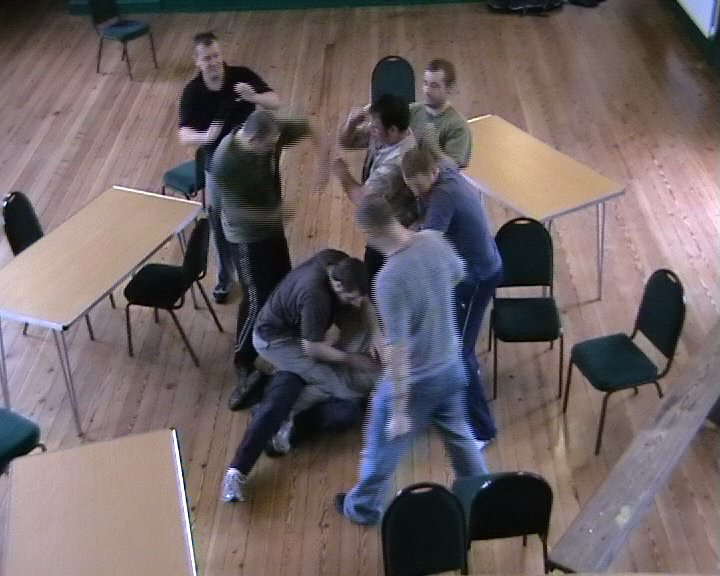
The third is to create an environment where each component involved, each of the "systems" within a person,  can be trained, tested, refined in interactions with other people

Where this runs counter to "conventional" martial arts is that there is no set of movements. The aim is not to overlay choreographed patterns of response onto a person but to allow them to discover (re-discover) and refine their own movement pattern, which is as unique to each of us as our own handwriting. This can be as simple as having a person rotate the waist while moving the shoulders up and down, a natural pattern that provides the basis for so many types of movement. I have found that people quickly grasp the concept and discover for themselves that this is "movement for life", it is a liberating experience.

I can fully understand why some instructors are unable to get on with this concept, it calls for a creative and adaptive approach. Usually as an instructor you are "in charge"of the class, you have a syllabus to run through, information to explain, you are the most important person in the room, especially in a formal or institutional setting. I find when teaching Systema almost the complete reverse is true. I never know which direction a class is going to take because it is comprised of 15 or so individuals each with different strengths and weaknesses, each of whom has questions - and also answers.

So learning becomes a group endeavour. I find it a more adult way of teaching  as opposed to feeling  like you are back at school sat listening to a teacher drone on for half an hour and being treated like a child. The "natural" approach is dynamic learning -  if a question is raised we can look at different answers and test them there and then to see which works best for whom.

None of this is to say that relevant technical or medical information cannot be added in - of course it can. But we have to remember the principle of map and territory, the real understanding is in the doing. I can read up on how to fly a plane and "understand" it fairly quickly. But without real air-miles it is not functional knowledge. Another thing to consider is that this type of information can be just applying names to what you are already doing - after all you can't do anything without "doing" bio-mechanics. Revelations such as "your arm bends in the middle and can pivot around the elbow" are hardly news to anyone. Understanding  the role of tendons or the mechanism by which  muscle tension can be overcome when "stretching" are of more use. Even more interesting to me is information on such things as Fixed Action Patterns, OODA loop and the more psychological aspects. Of course physical condition is important, but survival /success  is often determined in the psyche, especially if you are physically impaired in some way

Nor does it mean that it's ok to be lazy about our training. It isn't, but people need to find their own motivations and strengths, not rely on me shouting at them to do another press up. A big part of the training is to take responsibility for yourself and to understand your own strengths and weaknesses. This understanding will feed back into everything you do and empower you to help those around you too

If we return to our fantasy model at the start, we begin to see the limitations of such an approach. A lot of the training I experienced previously was based on everything being perfect. I was well trained, in good shape, on mats, in a nice room with a good idea of what was about to happen.  Real life is cold, dark, hot, drunk, bad leg, sun in eyes, pissed off, half asleep, weaker than the other guy, outnumbered, shit scared......we are going to get hit, we may get damaged and even if we prevail there may be longer term consequences to deal with

This is why our work needs to be behavioural, what we are not what we do. In training get hit, get cold, get wet, get to a point where you think "FFS....."  Put aside any notions of toughness or persona, understand acceptance of what is happening now and how you deal with it....... that is where the learning starts


Merry Christmas and Happy New Year!

I just wanted to wish you all a Merry Christmas and a Healthy and Happy 2013!

Thanks to everyone who has attended classes and workshops this year as well as bought the DVDs / digital downloads. Your support and hard work is much appreciated!

It's been a great year for training, personally I've got to train with Martin once and Vladimir twice this year, in Hamburg (thanks Jorg!)  and at the great weekend in London organised by Systema GB - thanks guys!

There's been some great progress in training this year, reflected in the fact that a number of the lads are now Instructors  / Instructors-in-training - well done chaps!

It's also been great to see the new level of Instructors coming through, guys such as Jamie, Garreth and Mark, the Celtic Contingent as well as hook up again with "old faces" such as Sam and Dima :-)

If there has been one over-riding theme in the training this year it has been "natural movement". So it is only fitting that the last blog of 2012 should be on my views / understanding of what that phrase means

Next year looks equally exciting - Valentin Talanov in London, Martin Wheeler in Dublin and all the usual fun and games in-between. We also have a very interesting and different Summer Camp in the pipeline, so watch this space.

Thank you all once again and thanks as always to Vladimir and Mikhail for their continued guidance, inspiration and support

Rob

Natural Movement Workshop

Here's a clip from the recent workshop on Natural Movement, now available on DVD as Natural Movement Vol 2

CLIP


Thursday, 6 December 2012

Systema and Tough Mudder

Today's blog is written by one of our Tempsford guys Nick Stafford. Nick recently completed the Tough Mudder 12 mile obstacle race and after hearign him talk about it at the last session I asked him to write up his experiences. Over to Nick.....

I was fortunate enough to be introduced to Systema 2 years ago. The drills, the exercise, the relaxation and the camaraderie had me hooked. It took me a little while for me to realise that Ssystema was more than a martial art and the penny continues to drop on a daily basis why Systema practitioners train how they do.

As some of you guys already know i have recently completed "Tough Mudder" a 12 mile assault course designed by British Special Forces and at the ripe old age of 38 and having one too many bacon sandwiches I never dreamt that this was something I could achieve.It tested me to my limits and I know without Systema I would not have done it.

There were many times throughout the course that my Systema drills came into play, sometime instinctively at other times consciously. I am no  Systema expert and have no other martial art experience but in a relatively short time it has given me the tools I needed in order to accomplish my challenge. It surprised me that when I thought I could give up or go no further the things I have learnt from Systema got me through on such a noticeable scale.

The biggest help was the breathing. I focused on this for pretty much the whole course, especially the burst breathing to aid recovery -  but also the some of the other drills helped me regulate my composure in time of panic and relaxed parts of my body when tension was creeping in.

A lot of my movement was aided also instinctive as I moved over and under obstacles through the swamps and due to the nature of the course I fell over quite a few times, rolled nicely, unaffected and able to continue without breaking my flow. I even used Systema massage techniques on my team-mates when they went down with cramp!

So I am pleased to be studying Systema under the instruction of Rob Poyton at the Cutting Edge group in Tempsford. I know i have only scratched the surface of an endless learning curve but can feel the benefit and the effect it has on my day to day living and on any challenges i come up against in life whether physical or mental.

For those wanting to know more about Tough Mudder follow this link:
http://toughmudder.co.uk/

Nick (first time blogger)

Thursday, 22 November 2012

Beginners Guide to Systema - and Systema Guide to Beginners

This blog was prompted by a post from Mark Jakabcsin on Facebook concerning some recent experiences he's had with new students in class. So it got me thinking about the two sides of the coin - the new student and the instructor. I've listed out a few ideas and thoughts here, I'm sure it's old news to the experienced but I hope it gives some food for though for new instructors / instructors in training

SYSTEMA BEGINNNERS

What should you look for in a Systema class? It's a difficult question in some ways as Systema is a generic term covering a wide range of approaches. Add to this the fact that, in some schools at least, trainers are encouraged to develop their own flavour of Systema , there is  no set syllabus, etc and you can see how a beginner may get confused. So  here's a few of my own thoughts on what to look for:

1. Instructor Credentials
Is the instructor a recognised affiliate to any of the major branches of Systema (Vasiliev, Ryabko, Kadochnikov, etc).  Martial arts is notorious for self-appointed instructors, self-promoted dan grades and self-titled masters and experts. The fact that an instructor is an affiliate improves the chances that you are getting good information and training

2. Marketing Methods
These days it is very easy and cheap to set up an attractive website and promote yourself across the internet.
Bearing this in mind you should not use internet presence as a sole guide to good instruction. There are very good teachers in all styles who maintain a low profile. Of course the martial arts world also has it's share of those inflate their background and skills or who's internet presence belies the size of their school. Having said that a well organized website with lots of video clips and information can be very helpful in giving you an idea of how the school operates and the background of the instructor.

3. Communication
Contact the instructor prior to attending. How do they deal with you - polite, dismissive, helpful? This will give you some indication of what you can expect. However please don't expect a 45 minute conversation over the phone about the history of Systema or "is it like kung fu". Oh and please remember to call at appropriate times. I've had calls at 11.45 at night before - instructor's have lives too!

4. Class
Turn up a few minutes early for class, it will give you a chance to introduce yourself and ask any brief / relevant questions. Let the instructor know any medical problems or concerns you have
Follow the instructions for exercises and drills, bear in mind they may not all be competitive in the usual sense. If in doubt check what the drill boundaries are, what the aims of the drill are and work appropriately

In a good group your training partners will be helpful. Typically as a new person you will be paired up with an experienced student who will guide you through. Ask any relevant questions you have, though also bear in mind the answer is often to be found by doing the drill. Not everything is obvious at first and if you have previous experience in other martial arts some drills may seem odd to start! Be patient and soon enough you will see the relevance and reap the benefit

Systema training is generally conducted in an informal environment.However it should still remain focussed and challenging in the right places. If at any point you feel the training is too uncomfortable, dangerous or innappropriate, then step out of the drill. Beware any instructor who demeans people for not being "tough enough"

I've always found there is a high level of humour in training, though this is of the self deprecating or general kind rather than the sort of locker room / racist humour used to put others down. Any sign of pecking order, bullying, so-called "alpha males" or similar should be taken as warning indicators

5. Content
If you attend a Systema class you should reasonably expect to be taught Systema. If most of the class has you doing something else you may need to question the instructor's  credentials. Having said that one of the strengths of a good class is the different type of people you get to work with. So it may well be the case you find yourself training with a good boxer - in which case there should be no problem in asking him to feed you boxing attacks. As Systema is not defined by forms, kata or techniques there is ample room for your own freedom of expression. The instructor's job in this case is to guide you to efficiency, power development, psychological understanding, etc . The tools to do this vary according to both instructor and student

Teaching styles will also vary - some may offer no explanation, others may offer a lot of technical information. Whatever the approach the majority of class should be about gaining understanding through good practice

6. Post Training
Most Systema classes finish with a circle-up. Everyone in the group gets the chance to express any thoughts or questions about the training, or wider topics. Again keep in mind that everyone should get a chance to speak and don't monopolize! However you should feel free to air any concerns or criticisms. You should always feel able to speak one to one to the instructor about any concerns, or indeed suggestions

7. Overall
You should find a good Systema class enjoyable and a bit challenging. I know that people sometimes look at our clips of taking strikes and  feel nervous about attending. but there is really no need - all drills are voluntary and the work is always progressive, one step at a time. People often surprise themselves as being much more capable than they think!

For more information about our training see What to Expect in a Systema Class

SYSTEMA INSTRUCTORS

A few thoughts on dealing with new students

1. Be polite and informative when dealing with enquiries. People who want detailed information about history background, methods should be pointed to  relevant resources on the web or elsewhere

2. Allow time before class for new people to introduce themselves. Answer any relevant questions, take note of any medical problems

3. Where possible partner newcomers up with an experience student. Monitor beginners, make sure they are not getting overwhelmed or are going outside the drill. Be ready with a few words of explanation if needed, or to appropriately demonstrate if neccesary

4. Don't overload newcomers with information. This also applies to your other students. I've seen a newcomer be given  highly detailed explanations of a particular drill and stand there looking bewildered. The call then comes to "change" and the person has had no chance to actually do the drill

5. Be aware that different people process new information in different ways, some visual, some by explanation and so on. Systema teaches you to be adaptable, that applies to teaching as well as to "work"!

6. Be aware of anyone in the class stepping out of drill boundaries. Always be clear about what the boundaries are and what the purpose of the drill is. Stepping out of the drill can take a few forms -

Levels of contact  too much or not enough

Speed / intensity  the same

Experience levels - the more experienced should give the less experienced the opportunity to work and not overwhelm them

Talking - may be about the drill or it may be something else entirely, the most common being "when I did -x- we did it like this". Again this is cheating  the other person out of the experience of the drill

Inappropriate behaviour (outside of drills that call for them!)  - loss of temper, insults, bullying, sexual innuendo or behaviour, emotional distress

How you resolve these issues varies according to context but in most cases a quiet word will suffice. In some cases more direct intervention may be required. I've only seen it happen two or three times over the years and in itself it can prove an interesting learning / teaching tool. Also don't underestimate the power of the group, if you have good students they will monitor / mentor newcomers too

7. Be open to a person's previous experience and bring it into the group. Not neccessarily martial art experience, it can be anything. Where appropriate allow students to share experience in class and incorporate into the training

8.. Class size - in the past I've taught groups of up to around 60 people at workshops. That's do-able for me with an assistant or two, but for regular class I prefer around 10-20. That gives you a chance to work multiple drills and gives a good variety of bodies for everyone to work with but still allows you to work one-to-one where needed. I also prefer running an open group. It is good in some ways to train only with a small regular crowd - it builds trust levels which allows you to explore deeper areas of training. but there is also a danger of stagnation. New people bring new challenges, new ideas and new skills to the group. I also have issues with those who deem others as being "not worthy" to train. We are all works in progress

9. Keep training - it's important for instructors to be students too! There is always more to learn, not in terms of "technique" but in how to refine your own work and how to communicate that to fellow students. Above all remember that as an instructor you are a sign-post, not the destination!


Friday, 9 November 2012

Politics

A wise man once said "as soon as you get three people together, you have politics" . In modern society almost every issue has a political implication, from views on health care through to where you go shopping

Martial arts is no exception - in fact when it comes to politics it's a towering inferno! I don't know how things were back in the old "traditional" days of the Asian styles (much the same I reckon) but I do remember the   80's  Wing Chun wars, the Preying Mantis feuds, the Tai Chi challenges..not to mention the machinations of varying governing bodies, inter-club rivalries and tournament fun and games. All in all it made  Machiavelli look like an amateur.

Interestingly enough the most incendiary disagreements were not between different styles, as you might expect, but amongst practitioners of the same style. Endless battles raged about lineage, the "true" transmission, who was on the inside track and so on. Huge importance was given to obscure matters of form and training that were completely irrelevant to anyone outside of the training hall (who mostly viewed it all as "guys wearing pyjamas")

The  internet has made the situation both better and worse. Better because it is now a lot easier to share and see information, you can find out about even the most obscure style. Worse because these arguments now spread online where, of course, you have the option to remain both anonymous and safely out of reach. I guess one positive point of those old arguments was that at some point there would be an actual physical interaction to sort things out (or at least give something else to argue about, eg "my shoes were slippery on the floor")

Anyway, enough of ancient history, what has all  this got to do with Systema? Just that there seems to be a lot of  politics flying around at the moment. We have had anonymous bad-mouthing for a while of course, but now it seems that who you train with is the subject of nudges and winks, rumour and gossip are doing the rounds and I saw recently it has even come to attempted hacking of websites.

Let me make clear my own personal position - and this is personal, my thoughts alone, I don't represent anyone else except myself. I don't mean to cause offence, this is purely how I see things, just my opinion.

I've always tried to avoid politics. Over the last 30 years I've trained with a wide range of people. What prompts my decision to train with someone is a mixture of  the information they have to offer, how they put it across and how they conduct themselves and their business. I've encountered  people with  little information and even less ethics, they generally fade out of the scene pretty quickly. I've encountered people with good ethics and information who I enjoyed training with and got something from.  There are people it would be interesting to meet / train with in the future, time and funds allowing

Then there are people  I have the opportunity to train with that I choose not to. Not out of any political motive or because I've been told not to. Simply because I don't think I would gain anything from it and/or because the way that person conducts themselves doesn't resonate with me. In a similar way I'd go pay top dollar to see Tom Waits any night of the week but wouldn't watch Coldplay if they were doing a free gig in the field at the back of my house. Your tastes may vary of course and you are as free as I am to make choices

So I hope that clears things up for anyone thinking that I make "political" decisions about where I train. Of course it's not the first thing I've been accused off on the internet and by no means the worst! That list includes:  being a cult member, running a "whites only" neo-Nazi training group, giving up boxing because it was "too hard", not being a "good martial artist" because I didn't demolish a beginner in sparring, having spent time in prison, claiming that I was "stab proof",  not teaching properly, being a weekend commando and being "good little doggy" in order to protect my position (I run a class in a village hall once a week!). No doubt there are many others!  All the claims have a couple of things in common - one, they make me laugh and two none has never been made directly to my face.

Of course you expect all this in the professional martial arts world, it's simply business. In a free market we all have to protect our "rice bowl" as the Chinese put it. Some choose to do that by putting down the "opposition" , directly or indirectly. To me it speaks volumes about a person's ethics and also reveals something else about them. For example someone who's attacks centre around  credibility or status is likely a person desperate for credibility and status

But this is by no means the only way to do business.  I've met  plenty of people across the styles who run their school / business in a spirit of co-operation and mutual respect. Some of them have talents way beyond their "status" in the martial arts world. They are all busy just getting on with things, they have the maturity to understand that grown adults make their own choices, based on a wide range of factors, probably the least of which is the certificate you have hanging on your wall or how big your pecs are

So having been around all these different teachers and styles, why settle where I am now? Simple answer - it has everything I'm looking for. In terms of information I'm barely scratching the surface, in terms of results the training and teaching methods have proven themselves over time and in terms of ethics I've encountered nothing but  generosity. A world away from  the expensive pyramid / franchise model, just a simple "turn up and train"

Am I bound by some rigid code or etiqutte? No, other than simple everyday good manners. Am I ever discouraged from trying different things or asking questions? No, in fact the opposite. Granted this approach doesn't suit everyone - it certainly doesn't suit the person looking to feel "special" or to be part of some elite training group, but each to their own.

People make different choices in life and I have respect for people who are honest about the reasons for those choices. People who can't make the grade or who feel let down in some way often feel they have an axe to grind. I can understand that,  I was in that position myself some years back, but learnt after a while to move on and find my own path, rather than keep trying to recycle old ground.

So please don't feel I'm being political if I make choices based on someone's actions or their attempts to undermine my friends and my business. It's not politics, it's  just plain old fashioned manners